


Note to new subscribers: If Greek linguistics is not your jam, you can unsubscribe just to this section (Language Analysis). You’ll still be sent my occasional reflections on the content of the Greek New Testament.
In this series so far, I’ve argued:
That scholarly articles on Greek are too dense for the vast majority of people to understand, and
That Greek studies needs a more rigorous, scientific approach, so that the best theories can emerge through testing and collaboration.
In this article, I will argue that the rigorous and scientific approach is foiled not only by a general shirking of the scientific method in Koine Greek linguistics (article 2), but also by the fact that many theories are so vague that they could mean anything. Broad and imprecise, they leave enough wiggle-room to (possibly) apply in every situation.
Actually, the vagueness seems to be the point. Lacking crystal clarity over what the perfect tense (for example) actually means, we make our definitions fuzzy enough that they must surely contain the correct meaning somewhere in there. It’s the Koine Greek version of an astrology columnist: ‘Something good will happen around the middle of the week. Be on the lookout for love!’ Such statements tend to work, if you have the will and the creativity to make them work. And, as they are notoriously hard to disprove, they enable believers to keep the faith.
As an example, let’s have a look at one scholar’s definition of the Greek perfect tense. This example is selected less because it is uniquely heinous and more because it is one of the rare gems written plainly enough to be easily grasped. (Hallelujah!)
There are three components to this definition. First, a verbal description. Admittedly, this carries a fair bit of jargon—but it’s common jargon, fully understandable to people in the field:
The perfect indicative semantically encodes imperfective aspect and the spatial value of heightened proximity. In this way, the perfect indicative is proximate like the present, but more so.
Next, there’s a diagram, in case readers need a visual to understand what ‘heightened proximity’ means. (Hint: it means ‘closer’.)
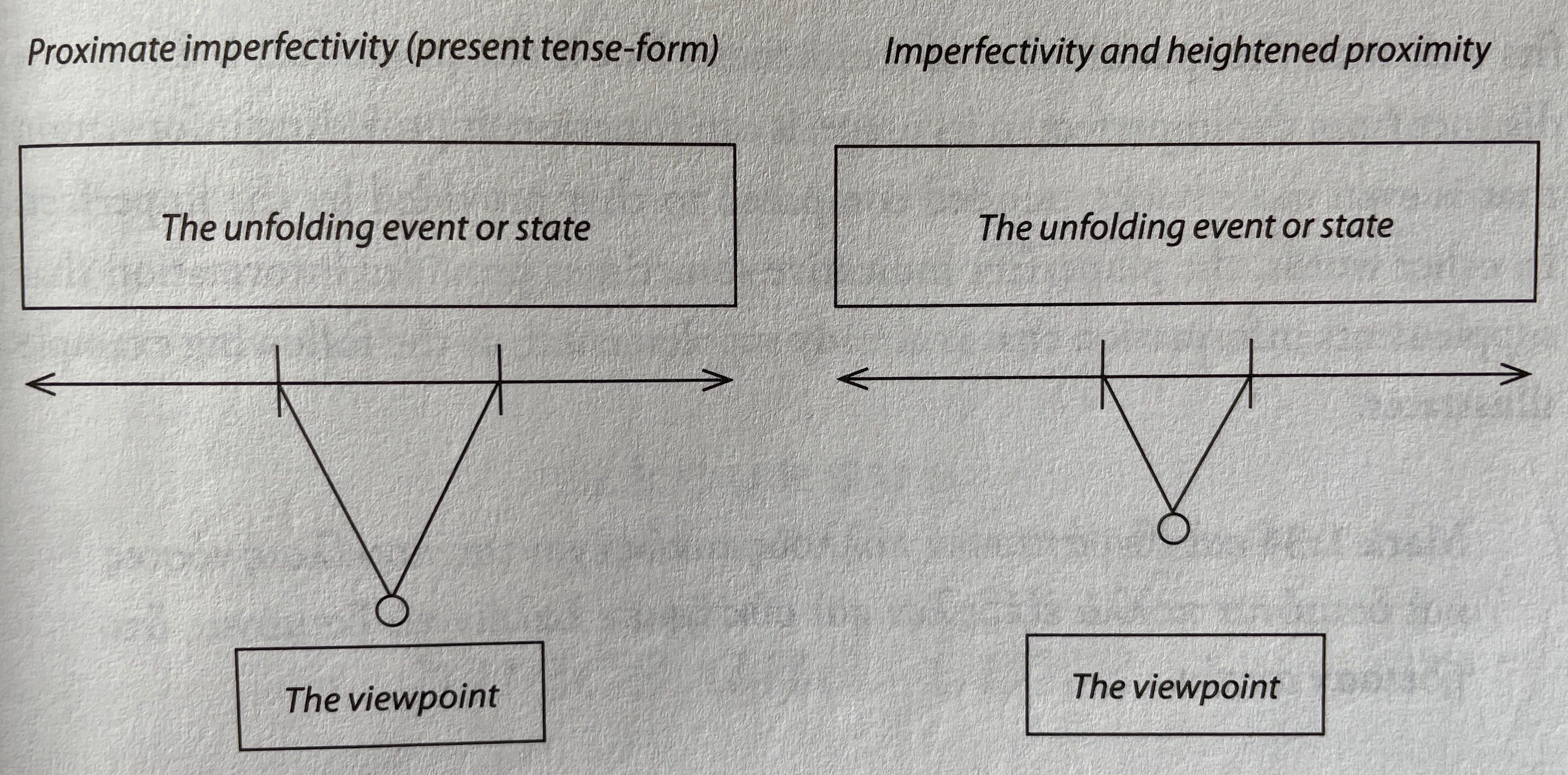
Finally, there’s an illustration, in normal English, as plain as you could ask for:
Using again the illustration of the reporter and the street parade, the second diagram represents his taking a step closer to the parade. The parade is unfolding immediately before his eyes, as before, but now is even more proximate; he is viewing the action close up. The effect of this close-up view is that it concentrates on the action by zooming in on it.
Wow! I think I know what he is saying about the perfect tense, and I only spent three minutes on that page. How exhilarating!
Now we’ve understood it, let’s talk about whether we agree with this definition. It’s always exciting to hear a fresh and unusual take on Greek verbs. It makes my heart skip a beat—maybe this will solve all those tricky cases where the traditional English gloss of the perfect (“I have VERB-ed”) just can’t be shoehorned into making sense. Let’s put this scholar’s theory to the test!
Well, here we run into trouble. What does it actually mean for a verb to portray ‘heightened proximity’? How does a writer ‘step closer’ to a verbal parade? The author says that these are bona fide spatial concepts—but how exactly does space relate to these verbs? Was Mary breathing down the neck of her (perfect-tense) belief when she said πεπίστευκα in John 11:27? Was the Pharisees’ arrival on the scene in Luke 5:17 that much more proximate because the perfect tense was used?
As a contrast to the perfect tense, the scholar argues that the aorist tense portrays spatial remoteness. Does that mean that the subject of the sentence is standing a few metres from the object? Or that the action is happening in Israel, while the writer is stranded on Patmos? Or is the remote aorist a nod to readers like me, who read the text way over here in Sydney?
All this nonsense is ruled out by the author. He concedes that the spatial terminology really is a metaphor. After all, the aorist tense is very commonly used for past time; the action is temporally remote, not spatially. But on the very next page, he kind of says it is literal spatial remoteness, or can be at least, if the temporal thing doesn’t seem to work. He cites an example where God utters an aorist from heaven, and he uses the aorist tense because his voice is heard waaaay down here on earth. #soremote!
So, sometimes we are speaking literally about physical remoteness or proximity. Sometimes we’re speaking metaphorically, about time. How do we know? What are the criteria? And even more importantly, does this theory in any way illuminate the text’s meaning for us—or does it only work if you look at it by the refracted light of Saturn’s twelfth ring on a clear Tuesday near the winter solstice?1
Below are a few sample verses from the Greek New Testament. In the English translation, I’ve noted whether the verb form is (according to this theory) communicating remoteness or proximity. As you read the verses, is the effect of remoteness or proximity apparent? Does it give you any ‘aha!’ moments? Does it help you understand what the author is doing?
Τοῦτο δὲ ὅλον γέγονεν ἵνα πληρωθῇ τὸ ῥηθὲν ὑπὸ Κυρίου διὰ τοῦ προφήτου λέγοντος Ιδοὺ̀ ἡ παρθένος ἐν γαστρὶ ἕξει… (Matt 1:22)
All this took place (very proximate) so that what was spoken (remote) by the Lord through the prophet might be fulfilled (remote), when he said (proximate), ‘The virgin will conceive (neither remote nor proximate) …
ὁ δὲ Ἰησοῦς στραφεὶς καὶ ἰδὼν αὐτὴν εἶπεν Θάρσει, θύγατερ· ἡ πίστις σου σέσωκέν σε. καὶ ἐσώθη ἡ γυνὴ ἀπὸ τῆς ὥρας ἐκείνης.
Jesus turned (remote) and saw (remote) her. ‘Take heart (proximate), daughter,’ he said (remote), ‘your faith has healed (very proximate) you.’ And the woman was healed (remote) at that moment. (Matt 9:22)
εὑρὼν δὲ ἕνα πολύτιμον μαργαρίτην ἀπελθὼν πέπρακεν πάντα ὅσα εἶχεν καὶ ἠγόρασεν αὐτόν. (Matt 13:46)
When he found (remote) one of great value, he went away (remote) and sold (very proximate) everything he had and bought (remote) it.
Perhaps you can make head or tail of this. But the general effect on me is whiplash, as the perspective changes from proximate to remote and back again, and more often than not, I’m left feeling like I’m missing something—that I must be a sad little Greek scholar indeed, who can’t fathom why one is proximate and another is remote, let alone predict the remoteness level required for a given meaning to emerge.
As I try to make sense of it all, the creative part of my brain starts champing at the bit. It wants to come out and play. But I say no! Be thou still, creativity! Remember: meaning-making is science. Creative brain is only allowed out for translation, imaginative immersion, and forming connections to aid exegesis. Creative brain builds something beautiful upon the flat, grey, concrete bedrock of understanding. If creativity must be called upon to explain why a particular verb is the way it is, that’s a crack in your concrete.
In the end, even if I can understand all the words of theories such as these, what they actually mean in real life—in real Greek texts—still evades me. Being vague, they are as useless to me as an astrology column, and equally untestable: we cannot say with confidence whether the theory is supported or refuted by, for example, the ἠγάπησεν in Mark 10:21, or any other real-life verb.
Why are vague theories so abundant in Koine Greek studies? I wonder if it’s because so many Koine Greek scholars come fresh from the theology department rather than linguistics. In theology, we get used to sitting in mystery. We talk about God, and we have no words. We move from ineffable, sublime, omniscient, and omnipotent, to substances and essences and perichoretic union in the Godhead. We make up woefully insufficient terms to try to capture something we cannot yet grasp, and know we never shall. But boy, we’ll have a lot of fun trying.
However, one doesn’t tolerate this kind of hapless resignation in science—nor the bizarre labels which accompany it. Either penicillin kills bacteria or it doesn’t. Either injecting yourself with disinfectant to prevent covid is a good idea or it isn’t. Bad physical science harms people. Bad language science harms us, too.
Yet there is hope—both for the incomprehensible definitions which I lynched in the first essay, and for the vague definitions targeted here. There is a way to refine and clarify meaning, and to communicate it in such a way that it is immediately comprehended (by scholar and non-scholar alike) and immediately testable. So sigh no more, φιλοι, sigh no more. In article 4, I will introduce you to a powerful linguist’s tool, and then I will show how it works as I bring you my home-grown definitions of the Koine Greek voices, and later, its tenses.
Then the fun will really start.
PS If you know the particular theory I critique in this essay and have found it useful, I would truly welcome your defense of it below.
PPS For the Greekies reading this, as I prepare my future articles, tell me, how would you define aorist and imperfect tenses? (Now, I can’t promise not to tear your suggestion to confetti next month, but I swear that if I do, I shall be utterly civil about it.)
As an aside, there’s another very important question which is rarely asked by Koine Greek scholars when evaluating novel theories. The question is: Do any other languages in the world do this? This question throws us to a field of research called linguistic typology, which looks at what happens and what never happens in languages. If no languages in the whole entire world exhibit such a phenomenon, or even no languages in the relevant language family (Indo-European, in the case of Greek), then watch out. Such a claim requires the same kind of exquisite and careful proof that you would need to convince the world that a black child is the natural-born offspring of two white parents.
Thank you so much. I'll look for these texts. The Septuagint and the New Testament will be my daily drivers, and I also look forward to exploring the huge treasure trove of Greek writing. Augustine loses a lot in even the best translation, so I suppose Plato and Aristotle will be more direct in the same way.
Not so long ago Latin and Greek was expected of every educated man. Many problems today can be traced back to breaking communion with the past.
What a cliffhanger